Walking After Knee Replacement: A Guide to Building Back Up
June 10, 2026
A pacing guide for walking during knee replacement recovery. Why walking is the most important thing you can do after total knee replacement, how to build up without overdoing it, and how to read the signals your knee sends.
You've had the surgery. You're home. And now you have to figure out what "walk as much as possible" actually means when your knee hurts and you're not sure how much is too much.
This is the part nobody fully prepares you for. The surgeon tells you walking is important. Your physical therapist gives you a home exercise program. But the day-to-day reality of building your walking endurance back up after total knee replacement is messier than any timeline or exercise sheet can capture. Some days you feel like you're making progress. Other days the knee is swollen and stiff and the couch is winning. It's hard to know when that's normal and when it's a sign you've pushed too hard.
This guide is for the period after you've been cleared to walk. Not the clinical question of when to start walking (that's your surgeon's call), but the practical work of how to build walking into your recovery in a way that actually helps rather than sets you back.
Why walking is the most important thing you can do after knee replacement
Proper walking is the best way to help your knee recover. That's the American Academy of Orthopaedic Surgeons being unusually direct, in a field that tends toward careful, hedged guidance. Of all the exercises and activities involved in knee replacement recovery, walking holds a specific place that the others don't.
The AAOS recommends walking 30 minutes, two to three times daily during early recovery, calling it essential to regaining strength and movement in the new joint. Whether that's the right amount for you, and how soon, is your surgeon's and physical therapist's call rather than a number to take from an article.
The reasons are layered. The mechanical reason is that walking puts your knee through its functional range of motion in a way that simulates real life. You're training the joint to work as a joint, not just as a set of isolated muscles doing prescribed exercises. The vascular reason is that walking moves blood through the leg, which matters enormously right after surgery. The CDC specifically advises moving around as soon as possible after surgery to reduce the risk of deep vein thrombosis, the blood clot risk that's elevated in the weeks after any major lower-limb procedure. Knee replacement is one of the highest-risk surgeries for DVT, and walking is one of the most effective ways to counter that risk.
There's also a reason that's harder to quantify but just as real: walking is how you learn to trust your new knee. That trust is earned through repetition, through the accumulated experience of putting weight on it and having it hold. People who walk regularly in the early weeks of recovery tend to build that confidence faster than those who avoid it. The knee replacement was done so you could walk normally again. The walking is how you get there.
What makes knee replacement recovery different from other injuries
Knee replacement recovery has a particular character that catches many people off guard, especially those who've recovered from other injuries or surgeries before. Many of the pacing principles for walking after surgery carry over, but a few things about this recovery are genuinely different. It also differs from a soft-tissue knee procedure like ACL reconstruction, where a healing graft, rather than a new joint, is what sets the pace.
The first difference is that you feel worse before you feel better, and that period of feeling worse is longer than most people expect. The surgery involves significant trauma to the tissues surrounding the joint: tendons, ligaments, muscle, and skin. The new implant is solid and mechanically sound almost immediately, but the surrounding tissue takes months to fully heal. The pain and stiffness in the first weeks are coming from that surrounding tissue, not from the replacement itself. This is important to understand because the pain can make it feel like something is wrong when the knee is actually healing normally.
The second difference is that knee replacement recovery is nonlinear. Progress doesn't happen in a steady upward slope. A good day is often followed by a harder day, especially in the first six to eight weeks. The knee swells in response to activity, and swelling stiffens the joint, and stiffness makes walking harder, which can feel like going backward. This cycle is normal. The response to a harder day is not to stop walking but to walk less and recover, then build back up.
The third difference is the swelling timeline. After most soft tissue injuries, swelling resolves within a few weeks. After knee replacement, significant swelling can persist for three to six months. Some patients have noticeable swelling for up to a year. Walking within your tolerance helps manage swelling over time, but significant swelling after a longer walk is a signal that you've done more than your knee was ready for that day. It's information, not failure.
The pacing principles that protect your recovery
Start shorter than you think you need to.
The instinct after surgery is often to push as hard as you can, particularly if you're used to being active or if you feel motivated by having the surgery behind you. The more reliable instinct is to start shorter than feels necessary and build from there. A five-minute walk that you complete without significant swelling or pain afterward is a better first day than a fifteen-minute walk that leaves you limping and elevated for the rest of the evening.
What matters in the early weeks is not distance or duration but consistency. A short walk three times a day is more useful than one longer walk. The accumulation of gentle, consistent movement teaches the knee's surrounding tissue to adapt. Spikes of overactivity followed by days of rest slow that adaptation.
Pace by feel, not by time.
Walking pace after knee replacement is not about fitness targets. It's about smooth, even gait. The AAOS specifically advises walking as rhythmically and smoothly as possible and adjusting step length and speed to maintain an even pattern. A slow, even walk is better for the recovering joint than a faster walk where you're compensating or favoring.
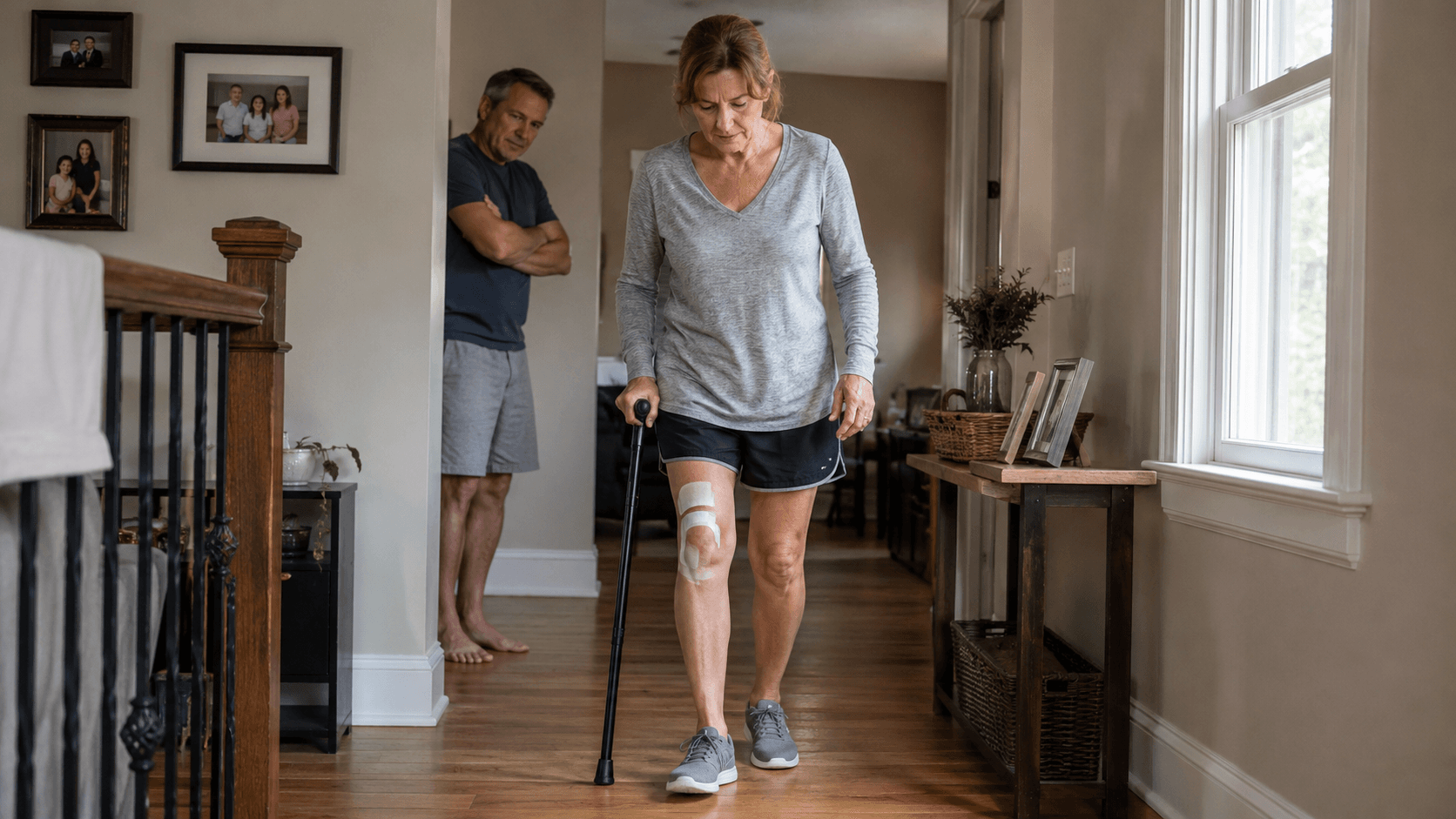
The practical sign that you're walking at the right pace is that your gait feels as symmetrical as you can make it. If you find yourself dramatically favoring the operated leg, slow down or shorten the walk until you can maintain better balance. Limping reinforces compensatory patterns in the surrounding muscles that can take a long time to undo.
Use the day-after test.
The best way to know whether a given day's walking was appropriate is to check the knee the next morning. The AAOS's activities guidelines indicate that the knee should not be significantly more swollen or painful the morning after a walk than it was before. If you wake up with notable increased swelling or pain that you didn't have the morning before, the previous day's activity was more than your knee was ready for. Reduce the next day's walking and let the swelling settle before building back up.
This is a reliable calibration tool: match your activity level to what your knee is telling you the next day, not to what you feel like doing on any given day. Good days feel like they want to be pushed; the day-after test keeps that impulse honest.
Build in rest between walks.
Two to three short walks spread through the day is the standard early-recovery pattern for a reason. The rest between walks allows the knee's circulation to normalize and gives the tissue time to recover. Doing three ten-minute walks with rest in between is usually better tolerated than one thirty-minute walk, even though the total time is the same. The spreading also keeps blood moving through the leg throughout the day, which supports the DVT prevention that matters so much in the first weeks.
Surfaces matter more than you expect.
Flat, even surfaces are the right environment for early recovery walking. Uneven ground, thick grass, gravel, or inclines introduce variables that are harder to manage when the knee is still learning its new mechanics. The risk isn't falling, exactly, though that matters too. The risk is that an uneven step sets off a muscle compensation that creates the kind of guarded movement that works against good gait patterns. Save the uneven terrain for later recovery.
When to slow down, and when to call your surgeon
Swelling and fatigue are normal parts of recovery and aren't reasons to stop walking. There are signals that are worth slowing down for, and signals that warrant a call to your surgeon.
Slow down and rest if:
- The knee is noticeably more swollen the morning after a walk than it was before
- Pain is increasing over multiple days rather than fluctuating normally
- You find yourself walking with a pronounced limp that isn't improving
- Fatigue is significant enough that maintaining an even gait isn't possible
Call your surgeon or seek immediate care if:
- The operated leg becomes red, warm, and significantly swollen in the calf (these are warning signs of deep vein thrombosis)
- You experience sudden shortness of breath or chest pain, which could indicate a blood clot that has moved to the lungs
- The wound shows signs of infection: increasing redness, warmth, drainage, or opening of the incision
- Fever develops
- Pain suddenly worsens significantly after a period of improvement
The distinction between normal recovery discomfort and a complication is something your physical therapist and surgeon can help you calibrate. When in doubt, call. A brief phone conversation is far better than a problem that goes unaddressed.
A note about the longer recovery arc
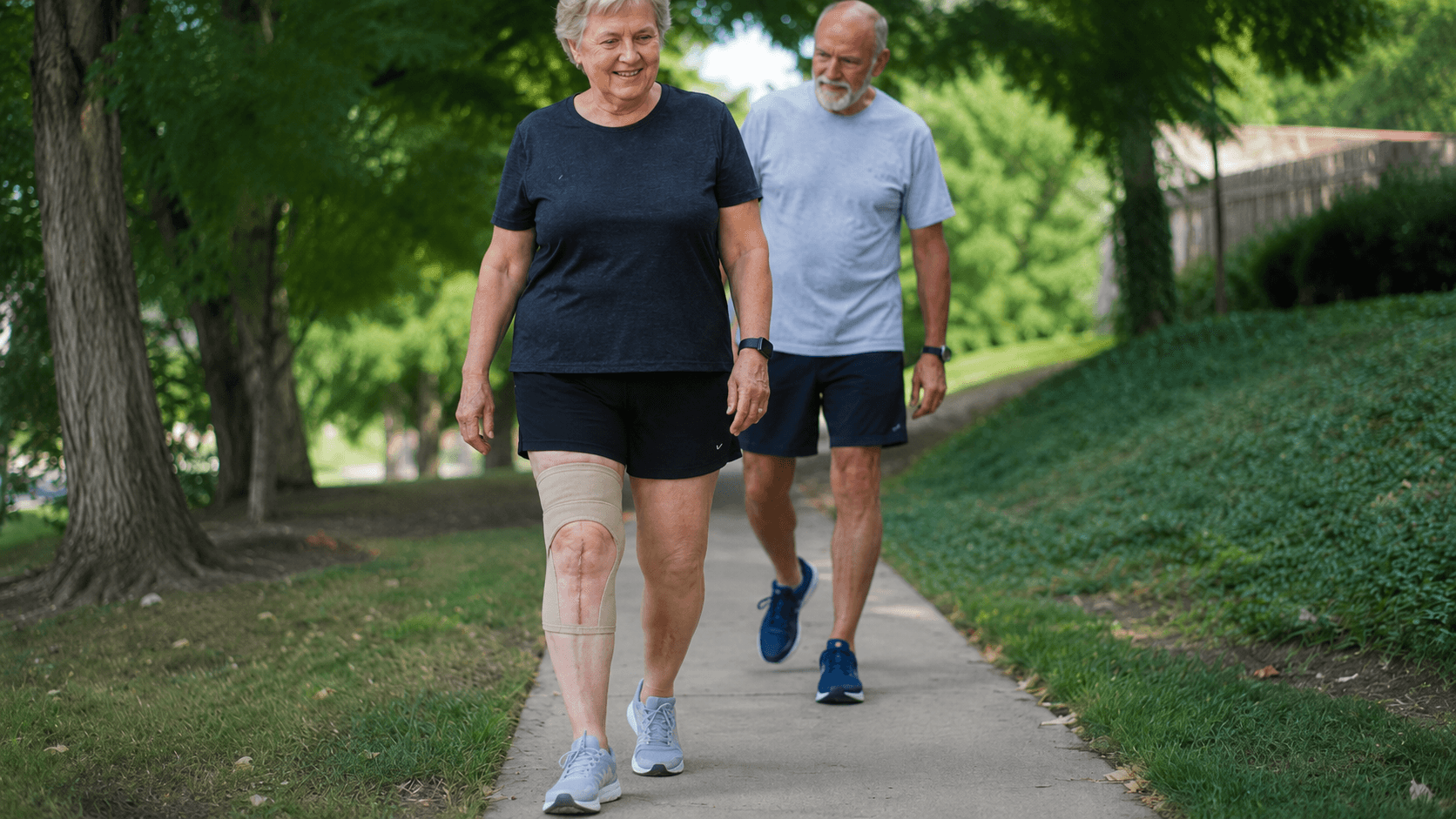
Knee replacement recovery is measured in months, not weeks. The AAOS's activities guidelines note that unlimited walking is one of the long-term realistic activities following total knee replacement, but the path to unlimited walking is gradual. By three to six months, most people find they can walk farther and more comfortably than they could before surgery, which for many patients is the first time in years their knee has allowed them to walk without significant pain. Getting there requires the steady accumulation of shorter walks in the early months.
The middle months, roughly six weeks to six months, are often described as the most frustrating part of recovery. The dramatic early milestones have passed. You're no longer using a walker or cane, and the crisis feeling of early recovery is gone. But you're also not fully recovered, and the improvements are smaller and slower. This is the period when many people either push too hard or give up on consistent walking. Both responses slow the recovery. The consistent, moderate walking that builds week by week through this period is what produces the long-term result.
How WalkReady fits into this recovery
The challenge of knee replacement recovery walking isn't that it's hard to understand. It's that it's hard to sustain. Knowing you should walk three times a day is easy. Doing it consistently for months, adjusting when the knee signals it needs rest, building up from short walks to longer ones at a pace that your knee can handle, is the actual work.
WalkReady is a walking app built specifically for this kind of recovery. It's session-based rather than distance-based, which means you're working through a graduated program that builds walking time incrementally rather than tracking miles or steps. The app is designed for people building back up after surgery, illness, or a long period of inactivity. It's free, and there are no ads.
If you're three to six weeks out from knee replacement and working with a physical therapist, WalkReady complements that care rather than replacing it. Your PT manages the clinical progression; the app handles the structure and consistency of the daily walking sessions in between.
If you've been told to walk and you're not sure how to build a routine that progresses safely, that's exactly what the app is for.
A few honest notes about this guide
This article was written to help you understand how to pace and structure your walking during recovery. It is not medical advice and is not a substitute for the guidance of your surgeon, your physical therapist, or the care team managing your recovery. Every knee replacement is different, and your timeline will be shaped by your specific surgery, your overall health, and how your particular knee is responding.
If anything in this guide conflicts with what your care team has told you, follow your care team. They know your knee; this article doesn't.
What this guide can do is give you a framework for thinking about the daily walking that is, by every clinical measure, one of the most important things you do in the months after knee replacement. The framework is built from AAOS guidelines, clinical research on post-surgical walking, and the consistent pattern of what helps people recover well. Use it in addition to, not instead of, your medical care.
The walking is the work. The app is there when you need the structure.